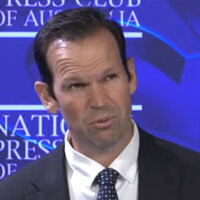



New Nationals Leader Matt Canavan wants to make it harder for permanent residents to become Australian citizens.
Canavanis reportedto have argued that citizenship standards had become too lax and that current hurdles to become an Australian citizen" (as opposed to a permanent resident) were more of a tick and flick, in contrast to tighter rules that he claimed existed when his Italian grandparents arrived in Australia.
Canavan goes on to say:
Three questions arise:
Is Canavans claim of lax citizenship standards accurate?
In a word, no! For the past 20 years, we have made access to citizenship harder and harder, but with very little to show for it in terms of improved social cohesion or integration.
While some will argue this is about improving national security, there is little evidence to support the assertion that making access to citizenship harder for permanent residents somehow improves national security. There is a strong argument that it is, in fact, detrimental to national security, as it increases frustration and a feeling of exclusion amongst permanent residents of Australia.
It is important to note that the process of becoming a citizen is a distinct and subsequent process to becoming a permanent resident. Many permanent residents continue to live in Australia for decades without becoming Australian citizens. This is particularly the case for citizens of the United Kingdom, who are amongst the most reluctant to take out Australian citizenship.
This is partly because, in practical terms, citizenship has little effect on the material situation of migrants in Australia. As permanent residents, they have access to the welfare support (after a four-year waiting period), Medicare, public education and so on,available to the general population. Humanitarian entrants also have access to special settlement services to assist them in participating in mainstream life as soon as possible.
The main material advantages of citizenship for migrants are security from deportation, an Australian passport and eligibility for permanent government employment (including in the armed services). The key requirement Australian citizenship imposes is the obligation to enrol to vote.
It makes sense to maintain high standards for access to permanent residence, but not much sense to then make access to citizenship difficult.
That is why, for 50 years, both Labor and the Coalition viewed citizenship through a social cohesion and inclusion lens rather than a material benefit and exclusion lens.
Suggested Cabinet submission for 2026-27 migration and humanitarian programThe Albanese Government is about to consider a cabinet submission on the 26-27 migration program. Former Immigration Department Deputy Secretary Dr Abul Rizvi has drafted IA's submission.
50 years of promoting Australian citizenship
For the period following the passage of theCitizenship Actin 1949 until the mid-2000s, both Coalition and Labor governments considered that maximising the proportion of permanent residents who become citizens was an indicator of the success of the migration program.
In 1948, then Immigration MinisterArthur CalwellsaidAustralian Citizenship:
In 1952, then Immigration Department SecretarySir Tasman Hayessaid:
However, take-up of citizenship remained low in the five to six years after the Citizenship Actwas made lawin 1949. Prior to changes made in 1955, the number of migrants making applications was very low: before 1952, less than half of all migrants had declared an intention to naturalise and of those who had, 75 per cent had not actually done so.
Numerous changes were made by the Menzies Government to the Citizenship Actin 1955to make it easier to secure citizenship, including:
- declarations of intention to apply for citizenship no longer had to be made two years before the application;
- applications could be made six months prior to the end of the five-year residency qualifying period; and
- the requirement for intending applicants to advertise their intentions in the newspaper was removed.
These changes brought a significant rise in the number of those becoming Australian citizens,jumping from4,770 in 1954 to 49,087 in 1959. Despite these changes, however, more than half of those who would have qualifieddid not apply for citizenship, with one of the most cited reasons being the level of English used in official documents.
From the early 1960s, the Menzies Government sought to further increase immigration, also leading to a surge in the numbers of those attaining citizenshipfollowing the introductionof a new and simplified application form in 1961: 53,211 people became citizens in 1962, which was an increase of more than 10,000 people on the previous year.
In 1966, the newHolt Governmentstarted the long process of abolishing theWhite Australia Policy, partly to further boost immigration levels. Thenew policy sawthe immigration program peak at 185,000 people in 1969. But in contrast, the number of those granted citizenship fell to 26,845 in 1969-70. Part of this would have been linked to the Vietnam War.
In 1969,further changes were madeto the Citizenship Act, including reducing the residency requirement for non-British migrants to two years, if they could read, write, speak and understand English proficiently.
While the Whitlam Governmentsignificantly reduced immigration levels, it alsochanged the Citizenship Actto introduce the same requirements relating to residence, good character, language ability, rights and duties of citizenship, and the intention to live in Australia permanently. These would be applied equally to everyone, with the oath or affirmation to be taken by all.
The Fraser Government made few changes to Citizenship policy, butdid seek to increaseimmigration levels, including through the establishment of points-tested migration, regularisation of overstayers, management of boat arrivals from Vietnam and implementation of theGalbally Reporton migrant settlement services.
The Hawke Governmentinitially reduced immigration levelsfollowing the 1982 recession. Itamended the Citizenship Actto remove discrimination in relation to sex, marital status and nationality. The English language requirement was changed from "adequate"to "basic"and applicants aged over 50 were exempted from the English language requirement.
References to "British subject"were grandfathered to reflect the national identity of all Australians. The following yearsaw a risein the number of new citizens with 114,914 grants of naturalisation in 1985-86, an increase of 20,000 on 1984-85.
The Citizenship Act was againamended in 1986so that not all children born in Australia would automatically become Australian citizens (ie abolition of birthright citizenship that is so controversial in the USA). The requirement for new citizens to renounce other allegiances was also deleted.
1989was declaredthe "Year of Citizenship" by Hawke and a letter was sent to every household encouraging those eligible to apply for citizenship. An advertising campaign was launched, as well as a telephone hotline. The publicity saw 130,312 peoplegranted citizenship in 1989-90, the most in any year in the 20th Century. This was a counter to John Howards concerns about too much migration from Asia.
The Keating Governmentand the early period of the Howard Governmentfocused on the promotion of citizenship to increase take-up.
In 1998, Howard established the Australian Citizenship Council underSir Ninian Stephen. In 2000, the Councilrecommended the abolitionof s17 of the Citizenship Act so that Australians would not lose their citizenship upon the acquisition of another countrys citizenship, as well as more generous citizenship by descent provisions for children of Australian citizens born overseas.
Another citizenship promotion campaign followed.
But that was to be the end of a period of around 50 years where Australian governments sought to increase the take-up of citizenship. Citizenship would no longer be about social cohesion through inclusion.
Australias migration numbers defy both campsAnalysts expect new ABS data to show net migration holding steady around 315,000, defying claims of both a rebound and a collapse.
Making access to citizenship harder
Contrary to Canavans claims, governments have sought to make access to citizenship harder for almost 20 years.
Around 2005,John Howard started a debate on a citizenship test. That was not based on any research or independent review but a personal belief, largely associated with his antipathy to a multicultural society. He initially appointedJohn Cobbas Minister for Citizenship and Multicultural Affairs to progress his idea of a more formal citizenship test. In 2006, the Department of Immigration and Multicultural Affairsreleased a discussion paperon the merits of introducing the citizenship test that Howard wanted, Australian citizenship: much more than a ceremony.
In his foreword to the discussion paper, then Parliamentary SecretaryAndrew Robb, stated that Australia has:
Robb appeared to be suggesting that the test was a way to force migrants to learn more about the Australian way of life and values. That is a perfectly sound public policy objective, but its not clear that having to answer a few multiple-choice questions is the best way to achieve that. The"Good Neighbour" movementof the Menzies era was a much more effective way to achieve Robbs objective, but that sort of thinking was not consistent with Howards approach.
The Citizenship Act wassignificantly restructuredin 2007. It introduced a number of measures relating to national security, as well as the extension of the residency requirement to four years, including a 12-month period of permanent residence before making the application. It is this change that, in particular, has grown the portion of permanent residents unable to access citizenship.
The Howard Government introduced a new test requirement for citizenship applicants consisting of 20 multiple-choice questions drawn from a larger pool of questions and based upon information on Australian history, culture and values.English language skills would be assessed by the ability to pass the test in English. The stated aim of the test was that it 'would encourage prospective citizens to obtain the knowledge they need to support successful integration into Australian society.'
Failing the test did not mean the applicant lost their permanent resident status just that they would have to sit the test again and again if they wanted citizenship.
Areview of the testundertaken by the Rudd Government found the test was 'flawed, intimidating to some and discriminatory', and that the resource booklet needed to be rewritten in basic English to fit with the legislative requirements of the test.
Immigration MinisterChris Evansannounced that the resource book for the testwould be rewritten, the pass mark would be raised and questions would focus on knowledge relevant to the Pledge of Commitment rather than on broader general knowledge of Australian history and culture.
Stricter vetting of citizenship applications
Former Immigration Minister Peter Duttonmade two key changesto citizenship law.
First, he introduced legislation enabling the Minister to cancel the citizenship of dual citizens who commit certain crimes and have completed their sentences. This legislation was overturned by the High Court, leading to the Labor Government reintroducing a similar power, but to be determined by a judge rather than the minister.
Second, Dutton introduced much stricter character vetting of citizenship applications, despite the fact all permanent residents have already passed the character test. This would appear to be similar to Canavans current proposal for increased vetting to determine if citizenship applicants are "fit and proper"persons, beyond the character test they passed when they acquired permanent residence and have to pass again when they apply for citizenship.
Canavan may not be aware that Duttons stricter vetting achieved very little other than to increase processing times, backlogs and costs. The delays attracted severe criticism from theAuditor-Generaland theOmbudsman.
Presumably, Canavan wants to use a broader (and more stringent) "fit and proper"person test rather than just the existing character test. But unless that can be made into some sort of objective test that does not contravene theRacial Discrimination Act (1975),nor key segments of the Constitution (for instance,s116 relating to religion), the change may achieve little more than Duttons stricter character vetting.
A subjective fit and proper person test would simply be an administrative and legal nightmare. If Canavans concern is that migrants applying for citizenship do not have adequate English, then make them sit a dedicated English language test. But testing for their beliefs and behaviours sounds more like something that a totalitarian society would do at a re-education camp.
One Nations immigration policies: Confusion, copycats and costly mythsA closer look at One Nations immigration platform reveals policy confusion, borrowed Trumpian slogans and proposals that collapse under basic scrutiny.
What a subjective fit and proper person test may achieve is a greater level of frustration and anger amongst permanent residents at another ham-fisted attempt at being excluded from citizenship. But perhaps that is Canavans objective along with the usual dog whistling to try and attract back voters crossing over to One Nation.
In this regard, One Nations proposalto increasethe residency requirement for citizenship to eight years rather than the current four is legally more deliverable, even if that would do nothing to increase social cohesion, as it would only further increase the number of permanent residents excluded from citizenship. Hanson may not be fussed about attacking social cohesion, as she seems to thrive on division.
In terms of citizenship policy, both Canavan and Hanson appear to believe the opposite of those who started and ran our post-War migration program for 50 years. They seem to believe that maximising the number of permanent residents who are excluded from citizenship is somehow a positive for Australian society. They are yet to explain why that would be so.
DrAbul Rizviis an Independent Australia columnistand former Deputy Secretary of the Department of Immigration. You can follow Abul@RizviAbulor [email protected].
Related Articles
- CARTOONS: Matt Canavan's National-isms are 'hyping up' Australia
- Coal canoodling Canavan says net zero is 'all over'
- Matt Canavan's anti-solar posts rely on his version of the truth
- The Canavan file: The curious case of a crime and a Senator becoming Italian
- CARTOON: The Canavan of courage